
Concrete Crack Repair Methods
Use this section as a guide to determine which product you should use. Applied Technologies has been supplying the waterproofing industry since 1998 with quality concrete crack repair materials and equipment. This includes concrete cracks in foundations, retaining walls and concrete slabs. Use this page as a guide to help you decide which repair method is best for your concrete crack. This section covers cracks such as hairline, actively leaking, structural, slab cracks or a floor crack in a concrete basement. Read on to learn the best concrete repair method.
The best way to repair a concrete crack in a foundation wall is by injecting it from the inside. The repair is quick and is therefore inexpensive. Injection ports are attached to the surface and a paste is applied over the crack surface. This cures and forms a strong seal to hold the injected epoxy or polyurethane in place. Then the liquid epoxy or polyurethane resin is injected into the crack. Once inside the crack, the soil on the exterior and the surface paste on the interior holds the liquids in place as they react. And then the repair is complete!
By far the number one question our new customers ask is "Should I use epoxy or polyurethane foam to fix my basement crack?" The vast majority of cracks in a foundation wall that leak water should be repaired using a polyurethane foam. This is for several reasons.
- More economical than epoxies
- Easier to use
- Cure faster
- Expand and fill voids
- Most cracks do not need re-inforcing from epoxies
Polyurethane Foams
Urethanes react with moisture in the crack to foam and expand inside the wall. This completely fills the void from top to bottom and all the way through. In fact, the urethanes can expand up to 30x their initial volume. Urethane foams are flexible and move with the expansion and contraction of a foundation wall from freeze/thaw cycles. Much less resin is needed with urethane foams since they expand in volume. That makes them much more economical than epoxies. Finally, urethane injection is relatively easier to do than an epoxy injection.
Polyurethanes Pros
- Less expensive
- easier to use than epoxies
- Inject actively leaking cracks
- Fills larger width cracks
- Flexible
Polyurethane Cons
- Not a structural repair
Polyurethane Foundation Crack Repair Kits
Polyurethane Resins
Epoxies
Epoxies weld the crack together and restore structural strength. The bond strength can be much higher than concrete. Movement is eliminated in the concrete wall during expansion and contraction cycles.
Foundations that are moving or have a continuing stress load on them may need additional repair methods to stabilize the wall and prevent further damage. The epoxy is stronger than the concrete, but the continued stress load may cause the concrete to crack again.
Epoxy Pros
- High strength weld
- Stronger than concrete
- Structural repair of crack
Epoxy Cons
- More expensive than urethanes
- Bond strength is lower when done in a wet crack
- Concrete can re-crack if the wall is still moving
- Epoxy Concrete Basement Crack Repair Kits
Epoxy Materials
Where to use low pressure
- Wider than hairline (wider than a fingernail or 1/32")
- Surface of the wall is dry
Low pressure injection using surface mounted ports, single or dual cartridge resin cartridges and a hand trigger injection gun is the most common method to repair a crack. Professional waterproofing contractors know that this system works for 90% of cracks that they encounter.
Click Here for low pressure injection polyurethane kits
Click here for low pressure injection epoxy kits
Where to use high pressure
- Narrower than hairline (less than fingernail thick)
- Actively leaking water
- Previously repaired cracks
- High pressure injection kit
High pressure injection uses drill in place packers to get the resin into the crack. A grease gun filled with resin is attached to the packer. This process is used on actively leaking, hairline or cracks that have already been filled with hydraulic cement. Higher pressures are needed to get into a hairline crack than a trigger injection gun can generate. Also, water on the wall surface from actively leaking cracks will not allow the surface paste used with low pressure systems to adhere to the concrete.
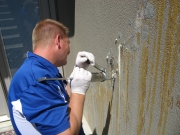 A foundation crack that is actively leaking water can only be repaired by using a polyurethane foam. They set up much faster than an epoxy so the water will not push all of the resin out before it has cured and expanded.
Our Acta-Leak Concrete Crack Repair Kit will stop the water from coming in a basement.
Because the surface of the concrete wall is wet, a surface paste cannot be used to adhere ports or to keep the resin in the crack as it reacts. But it is still possible to perform the repair by using the high pressure method.
Holes are drilled alongside of the crack and packers are inserted. The polyurethane resin is then placed into a grease gun. The grease gun is attached to the packers and the resin is pumped into the crack. On contact with water the polyurethane will begin to foam and expand, stopping the water.
At Applied Technologies we define a basement crack as "hairline" if you cannot get a fingernail into it. This is roughly 1/32" wide. Cracks as narrow as this can let in water. A low pressure injection using a manual dispensing gun may or may not be able to generate enough pressure to get the resins into the crack. A good tip on injecting them by low pressure is to warm the cartridges in water. This will make the resin thinner and more likely to enter the hairline crack.
For cracks that are extremely narrow, the high pressure system can be used to repair these cracks. This is done by drilling packers into the wall and using a grease gun loaded with resin to inject the materials. The grease gun method can generate much higher pumping pressures to get the resins into the crack.
The Acta-Leak Concrete Crack Repair Kit will repair hairline cracks.
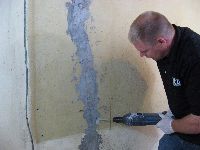
If your foundation crack was repaired previously by hydraulic cement, it is still possible to inject a urethane foam. The technician who first fixed the leak chiseled a vee-notch in the wall and then packed it with cement. Applied Technologies does not recommend you chisel out this cement.
We recommend the Acta-Leak Crack Repair Kit for cracks that have been previously repaired.
It is common for the seam formed where the slab meets the wall to leak. This water usually is coming up from below the floor due to the water table rising after rains. Injecting a urethane foam into this seam will stop the water in the area it is injected into. However, we DO NOT recommend injecting urethane foams of any type or manufacturer into this seam. This is because if the water is not able to enter the basement area, high water pressures can develop that causes a structural problem in the concrete slab or wall. A functioning drain tile and/or sump pump system is required for a proper long term solution for this problem.
Unfortunately, because a concrete block is hollow, it is not possible to inject a polyurethane or epoxy into them to seal off the crack.


